A Test of Faith
November 11, 2004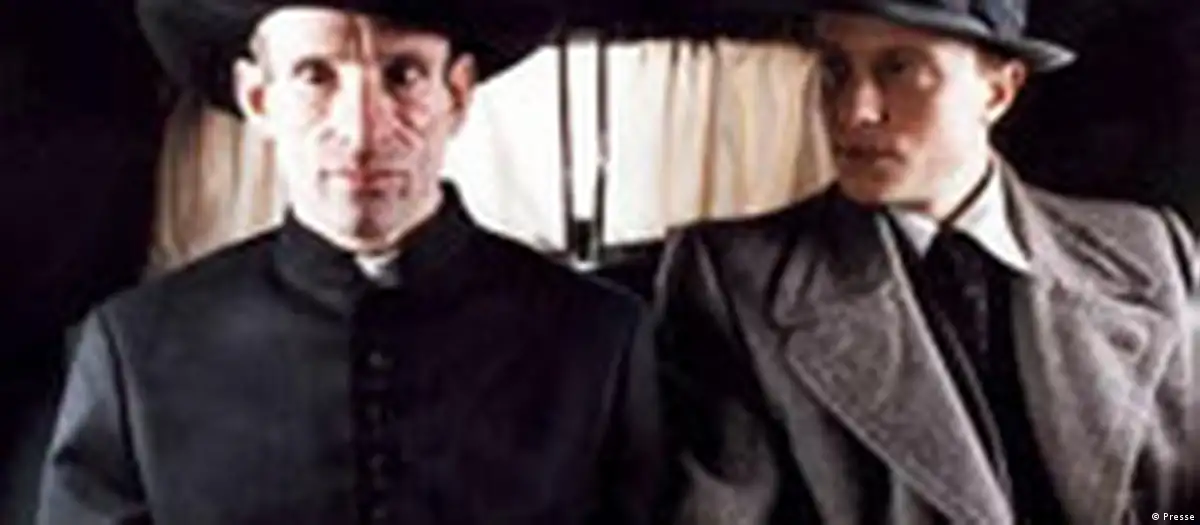
During the Nazi period, around 3,000 clergy throughout Europe who did not go along with the ruling regime were imprisoned in concentration camps. Volker Schlöndorff's new film, "The Ninth Day," is based loosely on the memoirs of one of those men, forced to choose between following his conscience or perhaps saving his and his family's life. The director, who won an Oscar for his 1979 film "The Tin Drum," has created a disturbing snapshot of relations between the Church and Hitler's regime.
In the film, opening on Thursday in theaters, Ulrich Matthes (photo) plays Henri Kremer, a priest from Luxembourg enduring the horrors of Dachau with others in the "clergy block." He is suddenly granted nine days' leave from this particular hell and allowed to return home.
But Kremer's furlough is not due to any sudden paroxysm of mercy on the part of the Nazis; their designs are much darker. Every day during Kremer's nine days of freedom he must report to a young SS man, Gebhardt, whose assignment is to get Kremer to convince the Luxembourg Church to collaborate with the new European masters.
To keep Kremer from simply disappearing during his furlough, his Nazi captors threaten to kill his fellow clergymen and harm his family if he does not report to Gebhardt as required.
War of words
Thus begins a dark chamber drama revolving around the verbal swordplay between the two men, which gains intensity daily. The weapons of the men, who find themselves on opposite sides of the reigning power dynamic but who both share a belief in God, are their arguments, and both have powerful arsenals on hand.
Gestapo officer Gebhardt, who once entertained thoughts of entering the priesthood, is not portrayed as a simple demon but given a dash of humanity. He attempts to bring the priest over to his side with arguments that prove surprisingly persuasive and darkly tempting. Both men have much at stake -- one risks his career, one his conscience or perhaps his soul.
A debate over the figure of Judas is one of the film's most powerful scenes, since Gebhardt argues that without Judas' actions, there would have been no crucifixion, the central event of Christianity. Judas, the Nazi argues, was an important cog in the wheel of history, no mere traitor.
Dark palette and portrayals
The movie has a somber, claustrophobic feel, helped by the director's chosen palette, made up mostly of variations of gray. The only intense color is the bloody red on the Nazi flag or flowing from wounds of tortured concentration camp inmates.
August Diehl as Gebhardt, blond haired and blue eyed, portrays a cultured, educated man, but one whose moral tether has been undone by rampant careerism and cold calculation. Ulrich Matthes is able to show the mental and physical turmoil Father Kremer suffers through his emaciated face, slow, deliberate gate, and eyes that appear haunted, unable to face his nearly unbearable choice.
"The Ninth Day" ("Der Neunte Tag," Germany, 2004) Director: Volker Schlöndorff. Screenplay: Eberhard Görner, Andreas Pflüger. Starring: Ulrich Matthes, August Diehl, Bibiana Beglau, Germain Wagner, Jean-Paul Raths. 97 Minutes.)